Mobilfunk Archiv (Englisch)

1
Dez
2005

Talk of ban on phone masts near schools

Mobile phone giants could soon be banned from erecting telecommunications masts near to homes and schools in the Telford area, amid growing fears.

It follows concerns from residents that the large number of masts in the borough are an eyesore and pose a health risk to children.

The issue was raised at a meeting of Telford & Wrekin Council last night when councillors backed a motion designed to allay public fears.

The motion called for a comprehensive and up-to-date register of all phone mast sites being made available to the public, a forum to liaise with the telecommunication firms and only to grant approval to applications for ‘targeted sites’.

Councillor Arnold England who proposed the motion, said he had the backing of campaigner, Bev Walker, and a representative from Telford Senior Citizens Forum.

Councillor Gary Davies seconded the motion, which won the backing of 24 councillors to 17, and will now be examined further by a scrutiny committee.

Back in August, Telford and Wrekin Council embarked on a review of its policy which is still ongoing.

The full version of this story appears in tonight’s Shropshire Star

http://www.shropshirestar.com/show_article.php?aID=39857

30
Nov
2005

PHONE MAST BLUNDER SLAMMED

Dec 1 2005

Renato Castello

THREE mobile phone masts refused planning permission have been erected on the Isle of Dogs because of a Tower Hamlets Council ``cock-up''.

Telecommunications giant Orange has installed the 10metre tall masts along Manchester Road because the council failed, within the legal timeframe, to notify the company that it had refused its application.

Unlike other structures, masts can be built by default if the council does not inform applicants within six weeks of it refusing an application.

In this instance, the council sent out the refusal notification a day before the six-week deadline and by second class post.

The masts, which have been designed to look like street lights, have been installed outside the Island Gardens DLR station, on the corner of Manchester Road and Glengarnock Avenue and outside Farnworth House, in Manchester Road.

The council had refused the masts in August 2004 following petitioning from residents. Conservative campaigner Tim Archer, who alerted The Wharf to the matter, said it was a ``cock-up''.

He said: ``This is sheer incompetence by the Labour-run council.

``Last year residents got the masts rejected and then the council can't even be relied upon to send out the legal notice in time.

``Part of me wonders if they did it on purpose. I suppose they will still be getting the rental income from the operator.''

A council spokesperson said the council ``regretted'' the mistake and said it was a ``one-off '' incident.

She added: ``The council takes all representations it receives on planning proposals very seriously and regrets that, on this occasion, those objections were ineffective.''

She said the council has changed its procedures so that all phone mast applications will be determined within 46 days and, if refused, telecommunication companies will be advised by recorded delivery.

http://icthewharf.icnetwork.co.uk/thisweek/news/tm_objectid=16432577&method=full&siteid=71670&headline=phone-mast-blunder-slammed-name_page.html
http://icthewharf.icnetwork.co.uk/thisweek/news/tm_objectid=16432577&method=full&siteid=71670&headline=phone-mast-blunder-slammed-name_page.html#story_continue

Les irradiations d’un téléphone mobile en forme de nounours pour les enfants de 4 ans leurs fait prendre un risque

http://www.next-up.org/pdf/article_news_telegraph_teddyphone_fr.pdf
http://www.next-up.org/main.php?param=dernieresinfos&date_news=2005-11-29

Un Militant du Groupe STS ( Spijkenisse Tegen Straling) enchaîné contre une installation UMTS d’Orange - Hollande

http://www.next-up.org/divers/image_semaine1.php

UMTS-3G en Hollande : Résumé en 60 secondes de la situation en date du 29 Novembre 2005
http://www.next-up.org/divers/editorial_situation_hollande_29_11_2005.htm

What a cuddly signal

http://www.buergerwelle.de/pdf/what_a_cuddly_signal.jpg

Hot on the heels of marketing the teddybear cellphone comes this RF energized teddybear pyjama.

Best, Imelda, Cork.

--------

Below today's Irish Times article I've typed in the info on the attachment (China) I sent you yesterday. Imelda


THE IRISH TIMES, THU, DEC 01, 05

"THE EXPRESSIVE DRESS THAT SHOWS HOW WOMEN REALLY FEEL
[by] Dick Ahlstrom

The latest in high fashion party wear has a little something extra to offer this year. A Dublin-based research group has developed a stylish dress that looks good but also tells you how the woman wearing it feels about you (right).

These are no ordinary ball gowns. One includes sensors that detect the heart as it pulses and matches the beat by lighting up a bright red panel across the front of the dress. The faster the beat, the faster the panel flashes, lighting up like a neon sign.

A second gown samples the wearer's "alert" response seen in changes to her "galvanic skin response", how well the skin conducts electricity. The more impact a male suitor has, the higher her alert status, and this raises - or lowers if you are not doing well - the brightness of spheres suspended in the garment's outer layer.

These gowns have the potential to take some of the mystery out of human relations but the goal is not to win hearts but to develop wearable electronics.

A number of dresses that combine fashion with electronic signal processing were developed by the Adaptive Information Cluster (AIC). The Cluster is a multi-disciplinary research group involving senior researchers from Dublin City University's centre for sensor research and School of Computer Applications, and University College Dublin's School of Computer Science and Informations, explains the head of the UCD school and an AIC principal investigator, Prof Barry Smyth.

The Cluster received Science Foundation Ireland funding worth €7 million and brings together the work of five PIs, says Smyth, "each of them a professor in either UCD or DCU". It combines the efforts of scientists working in disparate areas including sensor science, software engineering, electronic engineering and computer science.

Headed by DCU's Prof Dermot Diamond, the AIC started up about two years ago and involves the work of about 70 researchers, says Smyth.

PhD candidate at UCD Lucy Dunne carried out the research that delivered a number of "expressive garments" that include sensors that read the wearer's mood. They detect pulse rate, galvanic skin response, the "startle" response and whether the person is laughing, explains Dunne.

The gowns are smart in two ways, looking well but also capturing real-time information on a person's physiological condition. They incorporate sensor technology developed at DCU with electronics, but must still be able to go into the washing machine after the ball and come out working.

These are no ordinary sensors, she says. "It is a really nice crushable foam and integrates well into clothing and is washable."

Changes in the foam's shape produce changes in its electrical response, generating a signal that the smart dress interprets.

The trick is knowing where to put the sensor to get useable information, she adds. While the four gowns she designed, two of which have been installed as part of a display at the Brigham Young University Museum of Art in Utah, US, focus on individual expression, "most of my research is about function".

Wearable electronics could deliver many useful functions, particularly in the medical area. People with limited movement could activate switches or direct motorised wheelchairs using this technology.

Dunne has also produced a prototype sports jersey that monitors heart rate and respiratory effort and the technology could be built into trainers to monitor pace and gait.

© The Irish Times


IRISH INDEPENDENT, WED, 30 NOV, 2005

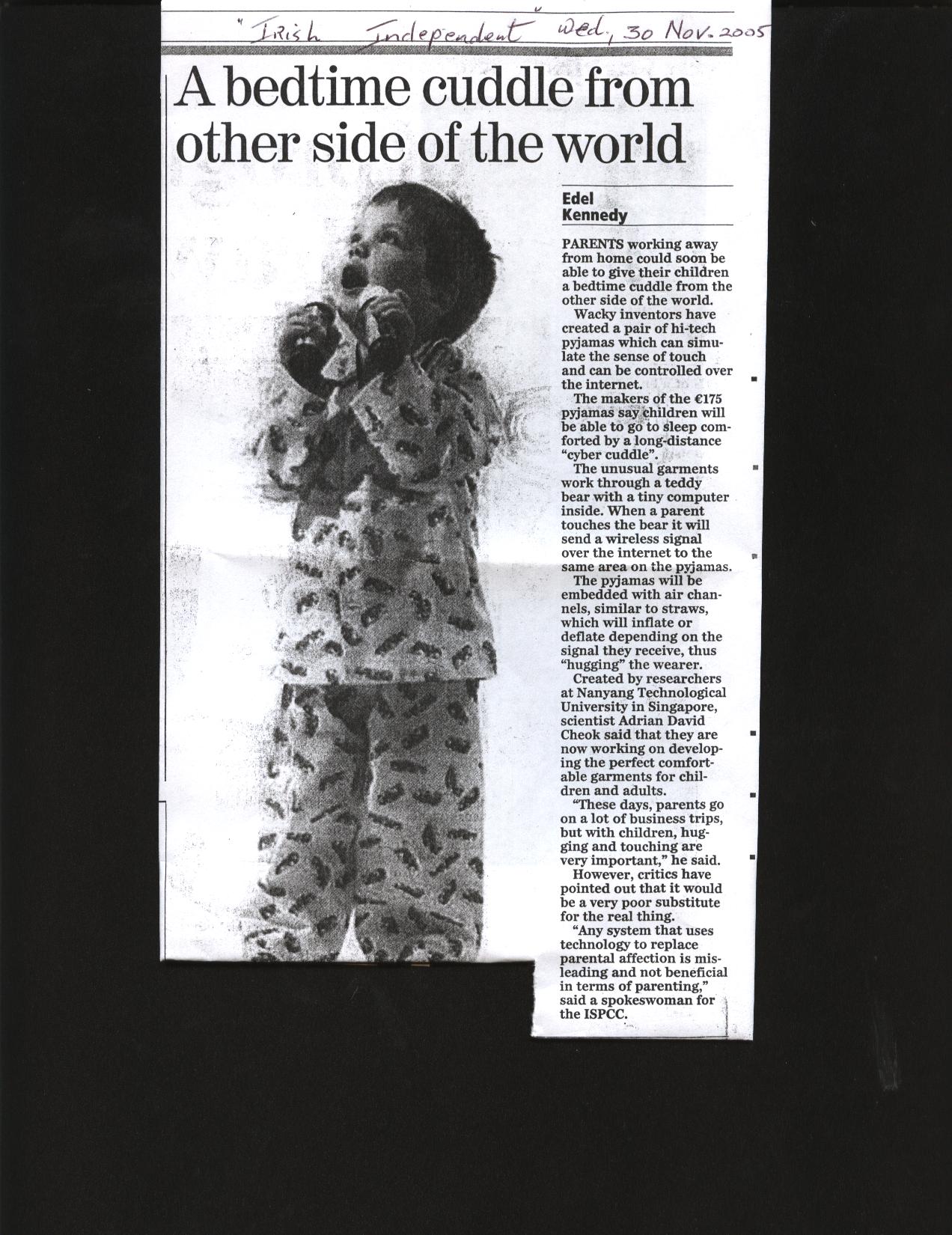
"A BEDTIME CUDDLE FROM OTHER SIDE OF THE WORLD
[by] Edel Kennedy

Parents working away from home could soon be able to give their children a bedtime cuddle from the other side of the world. Wacky inventors have created a pair of hi-tech pyjamas which can simulate the sense of touch and can be controlled over the internet. The makers of the 175 [euros] pyjamas say children will be able to go to sleep comforted by a long-distance 'cyber cuddle'. The unusual garments work through a teddy bear with a tiny computer inside. When a parent touches the bear it will send a wireless signal over the internet to the same area on the pyjamas. The pyjamas will be embedded with air channels, similar to straws, which will inflate or deflate depending on the signal they receive, thus 'hugging' the wearer. Created by researchers at Nanyang Technological University in Singapore, scientist Adrian David Cheok said that they are now working on developing the perfect comfortable garments for children and adults. 'These days, parents go on a lot of business trips, but with children, hugging and touching are very important,' he said. However, critics have pointed out that it would be a very poor substitute for the real thing. 'Any system that uses technology to replace parental affection is misleading and not beneficial in terms of parenting,' said a spokeswoman for the ISPCC."

--------

Teddy bear mobile ‘puts 4-year-olds at risk from radiation’
http://omega.twoday.net/stories/1204405/

Your Own Health and Fitness - Bad Reception

Recording of Olle Johansson interview

Notice from Robert Riedlinger:

Following on from last Sunday’s weblog #330 message about an interview with Olle Johansson and Doug Loranger in Canada, a recording of that interview is now on-line for one week.

Omega listen under:
http://www.buergerwelle.de/pdf/your_own_health_and_fitness_05_11_29.mp3 (over 10Mb)


[Source]
http://www.kpfa.org/archives/index.php?arch=11398

Your Own Health and Fitness

Tuesday, November 29th

Researcher Olle Johansson, MD, associate professor in the Department of Neuroscience, Karolinska Institute, Stockholm, Sweden, discusses long term studies showing the adverse health effects of exposure to radio frequency radiation from wireless technologies. Activist Doug Loranger discusses his film Bad Reception: The Wireless Revolution in San Francisco and community activism against citywide wireless broadband Internet access.

http://www.emfacts.com/weblog/index.php?p=336


http://omega.twoday.net/search?q=Olle+Johansson

SWEEP E-Bulletin 11

http://www.omega-news.info/sweep_e_bulletin_11.htm

29
Nov
2005

Help me to put a stop to mast bid

DAVID BALE

29 November 2005 12:18

Families are being urged to back a campaign against a mobile phone mast earmarked for installation just metres from homes.

Phone giant 3G is consulting people in Lakenham about putting a mobile phone mast on top of St John's Church in Howard Road. The proposed mast would be about 100 metres from the back garden of mother-of-two Naomi Leeder, 27.

She has started a petition against the plans and has collected about 150 signatures.

Mrs Leeder, of Osbert Close, said: "If it goes up, I will be moving. My eldest, six-year-old Rose, has only got one kidney and my three-year-old, Charlotte, has chronic asthma and eczema, so I don't want any more health risks on my doorstep."

Mrs Leeder, who lives with her husband Jamie, also 27, a taxi driver, added: "I've got a mobile phone and I'm not totally against it. I just don't want it so near my house," she said. "There are already about four other masts in the area, so I cannot see why they need another one." She has trawled the internet for more information about the health risks of living near mobile phone masts, which has increased her anxieties. "The main risk is cancer, which it says on the internet you are 10 times more likely to get, for women and children, and four times for men, if you live close to the masts," she said.

Mike Davies, community affairs manager at Hutchison 3G, said: "Our network has limitations and this site is designed to cover an area where some of those limitations are. All the science and evidence is plain that there are no health risks from this technology.

Omega this is not true. See under:
http://omega.twoday.net/topics/Wissenschaft+zu+Mobilfunk/
http://omega.twoday.net/search?q=Cancer+Cluster
http://www.buergerwelle.de/body_science.html


"Using a church has an advantage as it gives a revenue stream which can benefit the community."

The Evening News has campaigned against the installation of mobile phone masts near homes and schools until it is proved they are safe.

Dr Ian Gibson, Norwich North MP, and long-time supporter of our campaign, said: "Do they never learn? They are making themselves so unpopular with the public. Hopefully, this time, as they have asked for consultations with the people in the area, the people will put a stop to it."

If you would like to sign the petition, contact Mrs Leeder on (01603) 616248.

Are you fighting a mobile phone mast application?
Call David Bale on 01603 772427 or e-mail david.bale2@archant.co.uk

http://tinyurl.com/aym8c

Teddy bear mobile ‘puts 4-year-olds at risk from radiation’

By Nic Fleming,
Medical Correspondent

http://www.telegraph.co.uk/news/main.jhtml?xml=/news/2005/11/29/nfone29.xml&sSheet=/portal/2005/11/29/ixportal.html

A teddy bear-shaped mobile phone aimed at children as young as four was launched yesterday.

Article supplied by Sylvie

The new Teddyfone ‘is a response to clear demand in the market’

The manufacturers of the Teddyfone claimed it would help parents keep track of their children while minimising potential health hazards posed by radio frequency emissions.

With no screen and only four buttons that can be pre-programmed by parents, the device prevents users from being targeted by text message bullying, calls from strangers or inappropriate adult material.

The makers of the Teddyfone claim that the rate at which the body absorbs energy from the handset, known as its peak specific absorption rate, is 0.16w/kg - close to the lowest available. Most mobiles have SAR values of 0.4 to 0.7w/kg.

Sir William Stewart, the chairman of the Health Protection Agency, advised parents earlier this year to discourage use of mobile phones by children under eight as a precaution against potential health risks.

Yesterday the agency was joined in its criticism of the Teddyfone by even the industry body that represents mobile phone operators.

A spokesman for the Mobile Operators Association said: “The companies we represent don’t market their products to under-16s, as recommended by Sir William Stewart. We believe that is a responsible policy and is in line with the advice on health.”

Paul Liesching, the managing director of Teddyfone Ltd, who said the device was aimed at four- to 10-year-olds, pointed to research showing that a quarter of seven- to 10-year-olds owned mobiles. He said parents should be able to buy low-emission handsets that also protected children from other potential dangers.

“This is a basic parental decision. If you see the utility and benefits of your child having a mobile phone are greater than any potential risks, give your child a mobile phone. If you don’t, then don’t.

“One million children under 10 already have mobile phones which potentially put them at risk from text-bullying, excessive charges and inappropriate material. Teddy-fone is a response to clear demand in the market.”

The new handset has an SOS button that allows children who feel under threat to connect automatically to a parent’s mobile.

A child monitor option allows concerned parents to listen in to what is happening around their child and an optional child locator service sends parents a map of where their son or daughter is, on request, for 50p.

The handsets and two years’ line rental are free. Calls are charged at standard rates.

Sir William, the Government’s leading adviser on radiation, said in January that children under nine should not use mobiles and that those aged nine to 14 should make only short, essential calls.

He said: “When it comes to suggesting that mobile phones should be available to three- to eight-year-olds, I can’t believe for a moment that can be justified.

“My advice is that they should not have them because children’s skulls are not fully thickened, their nervous systems are not fully developed and the radiation penetrates further into their brains.”

Published research suggests that a child’s brain absorbs 50-70 per cent more of the emissions from a mobile phone than an adult’s.

Alasdair Philips, of consumer group Powerwatch, said yesterday: “Marketing a product at children when there is increasing evidence that it may be causing them both short-term and long-term harm is at the very least highly irresponsible.” Dr Michael Clarke, of the Health Protection Agency, said: “It’s up to any company to justify its product in light of our advice that children should be discouraged from excessive use of mobiles.”

Communi8, a British company, lost about £500,000 after launching Mymo, a mobile for under-eights, last year. It withdrew the product following Sir William’s comments.

A survey of 1,232 parents of children under 16 carried out on behalf of Teddyfone found that 35 per cent of respondents were concerned about the potential health hazards for children under 10 with mobiles. Nearly a quarter were worried about their child’s phone being stolen.

Publishers wishing to reproduce photographs on this page should phone 44 (0) 207 538 7505 or e-mail syndication@telegraph.co.uk

12 September 2005: Mobile phone fears for owners, aged five
http://www.telegraph.co.uk/news/main.jhtml;jsessionid=MRXLTO4TQXX4VQFIQMFSFFOAVCBQ0IV0?xml=/news/2005/09/12/nmob12.xml

14 August 2005: Mobiles aimed at under-8s set for return to high street
http://www.telegraph.co.uk/news/main.jhtml;jsessionid=MRXLTO4TQXX4VQFIQMFSFFOAVCBQ0IV0?xml=/news/2005/08/14/nkidmob14.xml

12 January 2005: Don’t allow under-9s to use a mobile
http://www.telegraph.co.uk/news/main.jhtml;jsessionid=MRXLTO4TQXX4VQFIQMFSFFOAVCBQ0IV0?xml=/news/2005/01/12/nmob12.xml


Source: http://www.emfacts.com/weblog/index.php?p=334

See also:
http://www.next-up.org/main.php?param=dernieresinfos&date_news=2005-11-29

--------

NRPB non-response re concerns over mobile phones for under-5s

You may be interested in the email below that I sent to Dr Mike Clark of the HPA-RPD (formerly the NRPB) two weeks ago. As you'll see, this is in response to his reply to an email from a member of the public in which they expressed concern about the marketing of mobile phones to children as young as 4 years old.

You may also be interested - as I am - that Dr Clark hasn't replied to my email in those two weeks - in marked contrast to his practice of responding to other queries I've seen within 2-3 days (I haven't emailed him myself before). It's very surprising that such an emotive and contentious issue hasn't produced a reply from the spokesman for the body that supposedly PROTECTS our nation's (and our children's) HEALTH.

You'll see I've raised a number of pertinent issues closely related to this matter. I believe ALL of these issues demand a response from the Radiation PROTECTION Division of the HEALTH PROTECTION Agency. If you feel, as I do, that a deafening silence on these issues is not good enough, then you might like to email Dr Clark as well - you'll find his email address below.

You may also consider various of the apparent contradictions that I've highlighted in my email below useful in objecting to 'inappropriate developments' of various types.

I shall be posting this text, and the email below, on my website http://www.starweave.com . As I know that the HPA-RPD (AKA NRPB) is in the Top 10 visitors to that site, this may encourage the response that has so far been lacking. I'm not including Dr Clark's email, as I feel that would be discourteous without his agreement. I will, though, say that he seems to take the view that his labelling of this issue as "political" puts it outside his remit - somewhat bizarre, for the body whose advice informs government policy on this subject.

Happy Christmas to all.

Grahame


----- Original Message -----
From: Dr Grahame Blackwell
To: Mike.Clark@hpa-rp.org.uk
Sent: Wednesday, November 30, 2005 12:41 PM
Subject: Teddyfone

Dear Dr Clark

I have recently been forwarded a copy of your reply (below) to S**** W**** on the subject of the 'Teddyfone'.

I would agree wholeheartedly with your view that the matter is political in nature. The sole reason that a company is able to market such a product to young children in this country is because a political decision has been made that permits this. That political decision has been made on the basis of advice from the body that you represent. If the advice from your organisation had been materially different then that political decision would most probably also have been materially different. However much you may wish to dissociate yourself from this commercial activity, it's only happening because your organisation has, in effect, given the go-ahead to such activities.

In your email you state "I suspect the company will argue that the product is an aid to child security." In fact, of course, the company doesn't have to argue any such thing. The company doesn't have to argue anything at all. It simply has to conform with ICNIRP guidelines - the 'Precautionary Approach' advocated in various documents published by your organisation. Perhaps you could explain to me exactly HOW this constitutes a 'Precautionary Approach' when the very reason for advocating such an approach, as documented in the Stewart Report and your follow-up Report 'Mobile Phones and Health 2004' (Documents of the NRPB) was that (I quote):

“There is now scientific evidence, however, which suggests that there may be biological effects occurring at exposures below these [i,e, ICNIRP] guidelines.

"We conclude therefore that it is not possible at present to say that exposure to RF radiation, even at levels below national guidelines, is totally without potential adverse health effects, and that the gaps in knowledge are sufficient to justify a precautionary approach. "

In other words, the reason that this product can be legally marketed to children of infant-school age is precisely because your organisation has seen fit to advocate, as a 'Precautionary Approach', those very guidelines whose perceived inadequacy has made such an Approach necessary. I know I'm not the only person who would be most interested to know the scientific rationale behind such an apparent 'do-nothing' policy.

It's also interesting to note that the Teddyfone itself is provided free and there is no line rental charge for 2 years. The manufacturers will be making their money solely from charges for calls made. I'd be interested to hear any business-minded supplier try to justify such a pricing policy on the basis that this is primarily an 'emergency-use--only' product, indeed I'm most surprised that you can even offer that as a plausible argument. The fact is, of course, that the commercial viability of this product depends solely on high call volume - from children of infant school age - and the manufacturers are well aware of that. Let's not kid ourselves - or try to kid anyone else.

Still on the safety angle, It's not clear to me what sort of situation an under-5 might find themselves in that necessitates such a facility. It's not the norm for children of that age to be set loose roaming the streets unsupervised. Is the Teddyfone in fact intended to reduce parental/carer responsibility for supervising infants, on the basis that "It's ok, they'll call us on the Teddyfone if there's a problem"? If so I'd suggest that this is a move towards less, not greater, safety and security for children.

I'm advised that, on a Canadian TV programme last Sunday (20th Nov) Sir William Stewart referred to the marketing of cellphones to under-8s as "grotesque" - a fairly explicit condemnation. Clearly he was on that programme purely by virtue of his position as Head of the HPA-RPD. I'd ask whether you, as spokesman for that same body, disagree with the views of your superior in this matter. If so, what are the public to think if the government's advisory body is divided within itself over the risk to young lives? If not, why is the HPA-RPD not sending out a very clear message to government on the inadvisability of permitting such profiteering at a potentially massive health cost to our children?

I was interested to note, too, your comment in the Daily Telegraph yesterday that "It's up to any company to justify its product" - and Sir William's observation in the same article "I can't believe for a moment that can be justified" (both relating to availability of mobile phones to small children). I've heard you say that yours is an advisory, not a regulatory body and so is not able to determine policy. I'd suggest that a watchdog with no teeth is of very limited value. If in addition it's hesitant about barking too loud, apparently for fear of upsetting those it's supposed to be warning about, then it's worse than useless - it gives the illusion of protection whilst in fact offering none. Even worse than that, by giving 'advice' that encourages government to implement a policy of virtually unrestrained commercial exploitation, that 'watchdog' is effectively holding open the door for all and sundry whilst tying the hands of any poor citizen who wants to protect his or her family (even the Mobile Operators' Association has expressed reservations about the Teddyfone - but it's still legal, thanks largely to your advice to government).

Dr Clark, you cannot have it both ways. You can't appear week after week in the media as the voice of official scientific opinion in the UK - and at the same time claim to have no part in the political process that permits an outrage like the Teddyfone (I use the term 'outrage' advisedly, it seems in keeping with the comments from Sir William Stewart and the Mobile Operators' Association). Whether or not it’s your intention there is no doubt that your position as evidenced in the Telegraph article is the very reason why “It’s up to [the] company” – central government hasn’t been given any good reason by its advisers to decree otherwise. Those little tots clutching Teddyfones this Christmas will be relying for their safety, not on the social conscience of a commercial operator, but on the ‘Protection’ that is central to your professional role. That 'Protection' is quite literally central - not just once, but twice - in the title of your organisation.

I’d be glad if you’d couch any response to this letter in terms that you’d be agreeable to being disseminated more widely; I know that there are very many people who would be interested in that response. If you make it clear in your reply that you would not wish such action, then of course I would honour that. You may also wish to know that the contents of this email are not at this time being displayed or circulated elsewhere.

Yours very sincerely

Grahame Blackwell

--------

What a cuddly signal
http://omega.twoday.net/stories/1211691/

Children and mobile phones
http://omega.twoday.net/stories/1063256/

Tracking by tagging our children
http://omega.twoday.net/stories/1240202/

EMF and childhood cancer
http://omega.twoday.net/stories/1239020/

Childhood leukemia and EMF
http://omega.twoday.net/stories/1239050/

28
Nov
2005

Next-up news 28 Novembre 2005

Next-up News France (par traducteur électronique)

03H50 - 28 novembre 2005 – Pays Bas

Des Militants contre l’ UMTS (3G) sont prêt à s'enchaîner à une barrière d'installation d'antenne relais ce lundi matin. Ils disent qu'ils seront satisfait seulement quand UMTS sera absolument interdit dans toute la ville de Spijkenisse près de Rotterdam.

Ce lundi matin l’opérateur Orange doit installer trois antennes d'UMTS sur un pylône de puissance, à environ 75 mètres des logements les plus proches. Les ouvriers seront opposés aux Riverains. "Nous les appelons comme des insectes dans tout le voisinage", dit Bertus van Drongelen. "pour aider et empêcher l'installation de ces antennes. Si les ouvriers ne partent pas, l'un de nous s'enchaînera à la barrière." Les Militants avaient déjà empêché l'installation en octobre.

Alex Swinkels, Bertus van Drongelen et Gerard de Kimpe ne sont pas simplement inquiétés des antennes relais UMTS. Ils savent que le rayonnement permanent de la téléphonie mobile peut avoir des effets de santé terrifiants. Il y a quelques heures ils ont rendu visite aux occupants des étages supérieurs du Marrewijkflat, un immeuble dans Spijkenisse. "80 pour cent d'eux se plaignent de graves problème de santé, d'insomnie au cancer", disent Van Drongelen.

Il y a déjà sur le Marrewijkflat plusieurs antennes relais de téléphonie Mobile.

Les mêmes problèmes ont été trouvés au 5ème et 6ème d'étage sur des immeubles opposées ou sont aussi installées des antennes relais de téléphonie mobile, ce sont les mêmes problèmes. Les occupants rapportent qu’ils souffrent "d’Insomnie, le mal de tête, la nausée et un sentiment général de fatigue". Certains d'entre eux urinent le sang. Les médecins et les spécialistes ne peuvent trouver aucune maladie ou anomalie connue. Quand les occupants quittent les lieux, ils se sentent mieux.

Mais dés qu’ils reviennent c’est de nouveau les mêmes symptômes.

Par conséquent, les Militants sont convaincus des effets des rayonnements sur la santé.

"il est impossible d'avoir une ville sans rayonnement. Le problème de la pollution par les rayonnements est trop complexe et il est trop tardif pour arrêter les autres antennes ", dit Van Drongelen. "mais au moins nous voulons une ville sans UMTS. Les citoyens doivent être mis au courant des risques des rayonnements." Selon des scientifiques, les rayonnements de la téléphonie mobile causent des effets toxiques".

Les Militants se concentrent sur toutes les antennes relais UMTS de Spijkenisse.

Le Conseil de la ville est derrière eux. Le conseil a décidé il y a deux semaines de ne plus accorder de nouvelles autorisations de pose d’antennes relais.

Le ˝Councillor˝ Gerrit van Buuren a demandé à l’opérateur Orange de respecter le souhait du peuple et de décommander l'installation. "Nous avons les autorisations et les documents, nous ne voyons aucune raison de s'arrêter", dit un porte-parole d’Orange.

Dans plus de 40 villes au Pays Bas les Conseils ont décidé de retarder les autorisations d’installation d’antennes relais de téléphonie mobile.

A Haaksbergen, les Fonctionnaires du comté ont empêché le fournisseur KPN d’installer des antennes relais UMTS (3G) sur un nouveau pylône. Les habitants de Haaksbergen sont fortement contre l’UMTS.

La Municipalité de Haaksbergen en ce moment refuse les autorisations.

Délibération de la Commune de Spijkenisse prise lors du Conseil du 10 et 14 Novembre 2005:

Considérant que:

- Les risques pour la santé des rayonnements UMTS ne sont pas connus.

- Que les ˝investigations˝ sont sans équivoques.

- Que les normes Néerlandaises sont significativement plus hautes que les normes internationales.

- Que beaucoup de troubles existent chez les habitants.

- Que face à cette confusion on ne doit plus prendre de décision.

Le Conseil de la Commune et l’Echevin retirent les permis récemment émis, et examinerons quelles sont les nouvelles étapes qui doivent être prises dans la Commune pour l’installation des antennes relais UMTS qui sont indésirables, et passe à l’ordre du jour.


Sources:
http://www.ad.nl/rotterdam/voorneputten/article69465.ece (Algemeen Dagblad,newspaper) interview by telephone with Bertus van Drongelen http://www.stopumts.nl
article in local newspaper The Botlek, November 28, 2005
http://www.stopumts.nl/pdf/motie2_spijkenisse.pdf and
http://www.stopumts.nl/pdf/motie1_spijkenisse.pdf (council decisions)

On constate de plus en plus d’actions directes contre les antennes relais, les exemples se multiplient en Europe, par exemple:

En Angleterre c’est une tour massive de l’Opérateur Orange très contreversée qui a eu ses boulons coupés par la ˝fureur des protestataires˝ et c’est abattu en pleine ville de Littleton. Lire la suite de l’article.

http://iccannock.icnetwork.co.uk/news/localnews/tm_objectid=16351507%26method=full%26siteid=75673%26headline=hated%2dmast%2dis%2dpulled%2ddown%2d-name_page.html#story_continue
logo

Omega-News

User Status

Du bist nicht angemeldet.

Suche


Archiv

April 2026
Mo
Di
Mi
Do
Fr
Sa
So
 
 
 1 
 2 
 3 
 4 
 5 
 6 
 7 
 8 
 9 
10
11
12
13
14
15
16
17
18
19
20
21
22
23
24
25
26
27
28
29
30


Aktuelle Beiträge

Wenn das Telefon krank...
http://groups.google.com/g roup/mobilfunk_newsletter/ t/6f73cb93cafc5207   htt p://omega.twoday.net/searc h?q=elektromagnetische+Str ahlen http://omega.twoday. net/search?q=Strahlenschut z https://omega.twoday.net/ search?q=elektrosensibel h ttp://omega.twoday.net/sea rch?q=Funkloch https://omeg a.twoday.net/search?q=Alzh eimer http://freepage.twod ay.net/search?q=Alzheimer https://omega.twoday.net/se arch?q=Joachim+Mutter
Starmail - 8. Apr, 08:39
Familie Lange aus Bonn...
http://twitter.com/WILABon n/status/97313783480574361 6
Starmail - 15. Mär, 14:10
Dänische Studie findet...
https://omega.twoday.net/st ories/3035537/ -------- HLV...
Starmail - 12. Mär, 22:48
Schwere Menschenrechtsverletzungen ...
Bitte schenken Sie uns Beachtung: Interessengemeinschaft...
Starmail - 12. Mär, 22:01
Effects of cellular phone...
http://www.buergerwelle.de /pdf/effects_of_cellular_p hone_emissions_on_sperm_mo tility_in_rats.htm [...
Starmail - 27. Nov, 11:08

Status

Online seit 8086 Tagen
Zuletzt aktualisiert: 8. Apr, 08:39

Credits